AI Citation Royalties: The Income Stream Most Authors Don’t Know Exists
A clear, honest map of how authors are starting to get paid when AI uses their books: who the players are, what they actually offer, what the money looks like today, and what to do about it now.
What are AI citation royalties, in plain terms?
In short: AI citation royalties are payments authors and publishers receive when AI systems use their work, either to train on it or to quote it in answers. The market is real but young. The biggest proof point so far is Anthropic’s $1.5 billion settlement with authors in 2025, though most ongoing royalty programs still pay very little.
Here is the honest landscape this article maps, each claim sourced:
• Two different money streams exist: paying to train on a book, and sharing revenue when a book is cited in an AI answer. They work very differently (The Media Copilot, 2026).
• The landmark event is Anthropic’s $1.5 billion settlement covering ~500,000 books at roughly $3,000 each, the largest copyright payout ever reported (Authors Guild; NPR, 2025).
• The major players, including CCC, Created by Humans, and ProRata, mostly serve publishers, news outlets, or do author-direct licensing, each on different terms.
• Real-world payouts so far have been, in one trade report’s words, “minimal at best,” because AI search adoption is still ramping (Digiday, December 2025).
• Even the founder of a leading platform calls future pricing “the billion dollar question,” so honest guidance means setting up to benefit without expecting a windfall (Created by Humans, via Publishers Weekly, 2025).
Why should authors pay attention to this now?
In short: Because a new revenue category is being built right now, and the authors who position themselves early will be ready when it matures. The money is still small today, but the legal and commercial groundwork being laid in 2025 and 2026, from billion-dollar settlements to recurring revenue-share platforms, points to a real, lasting income stream forming.
Let me be honest with you from the first sentence, because this topic attracts more hype than almost any other in publishing. There is a great deal of loose talk about authors “getting rich” from AI, and most of it is nonsense. What is actually happening is quieter and, in the long run, more important: a brand-new category of income is being constructed, piece by piece, in courtrooms and startups and trade associations. It is not yet a fountain. It is closer to the first small pipes being laid for a waterworks that may, in time, serve the whole industry. The authors who understand the plumbing now will be the ones connected when the water turns on.
The clearest signal that this is real, and not a fad, arrived in 2025, when the AI company Anthropic agreed to pay $1.5 billion to settle a class action brought by authors whose books it had used without permission (Authors Guild; NPR, 2025). That is the largest copyright payout ever reported, and it established a principle that will outlast the case itself: the work in books has value to AI companies, and that value can be made to flow back to the people who created it. Once a price has been put on something, a market tends to follow.
But here is the part the breathless coverage leaves out, and the part you most need to hear. The ongoing, everyday royalty programs that promise to pay authors when AI uses their work are, by the candid admission of the people watching them closely, paying very little so far. One December 2025 trade report found that the money paid out to publishers through these new schemes “has been minimal at best” (Digiday, 2025). This article will hold both truths at once: the foundation is real and worth acting on, and the income today is small and worth no fantasy. An author who grasps both will make better decisions than one who believes only the headlines.
What are the two kinds of AI royalties authors can earn?
In short: There are two distinct income streams. The first is training licensing: a one-time or recurring payment for letting an AI company use your book to train its model. The second is citation or answer-engine revenue share: ongoing payments when your work is quoted in AI-generated answers. They involve different players, different mechanics, and very different reliability.
The first stream, training licensing, is about the raw material AI is built from. AI models learn from enormous quantities of text, and books are among the most valuable text there is, being edited, coherent, and deep. Licensing here means granting permission for that training use in exchange for payment, whether a lump sum or an ongoing arrangement. This is the stream behind the Anthropic settlement and behind platforms that let authors offer their books to AI developers. As the technology law firm Norton Rose Fulbright noted in 2026, courts have begun to treat the training itself as potentially fair use while treating the acquisition of pirated copies as infringement, which is precisely what makes a licensed, paid path attractive to AI companies wanting to stay on the right side of the line (Norton Rose Fulbright, 2026).
The second stream, citation or answer-engine revenue share, is newer and works differently. Here the payment is triggered not when a model is trained but when your content is actually used to answer a question, with the revenue often coming from advertising placed alongside the AI’s answer. The startup ProRata, for example, pays publishers 50% of the revenue its Gist answer engine earns, split proportionally according to how much each source contributed to a given answer, on a recurring basis (Press Gazette; The Media Copilot, 2025–2026). The distinction matters enormously for an author: training licensing is a payment for access to your book, while citation revenue is a payment for your book’s ongoing usefulness in answering real questions.
Who are the major players in AI licensing and citation royalties?
In short: The main players fall into three groups: collective licensing bodies (Copyright Clearance Center, the UK’s PLS and CLA), author-direct platforms (Created by Humans), and answer-engine revenue-share companies (ProRata, Bria, TollBit). Most serve publishers or do direct licensing; few are built around individual book authors, and none today bundle royalties with full publishing.
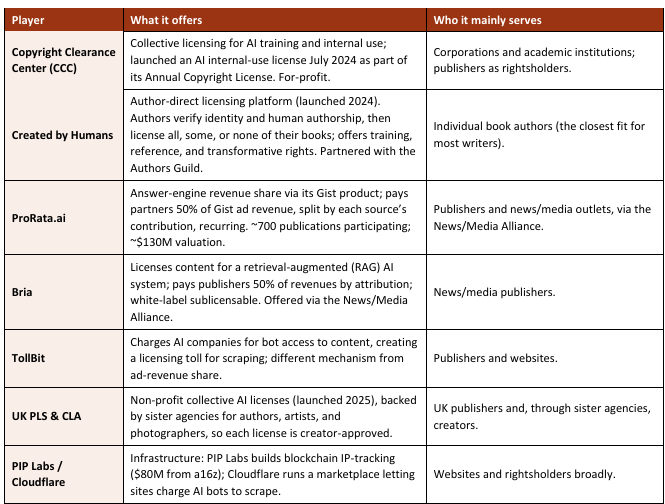
The table below summarizes the significant players and exactly what each offers. Read it with one caveat in mind: this is a fast-moving field, and terms change, so treat these as accurate snapshots from 2025 and 2026 rather than permanent fixtures.
What does each major player actually do, and what are the trade-offs?
Copyright Clearance Center (CCC) is the established collective-licensing body, and on July 1, 2024 it launched a collective license for the internal use of copyrighted materials in AI systems, an addition to its Annual Copyright License (Publishers Weekly, 2024). Its CEO, Tracey Armstrong, framed the philosophy crisply: “Responsible AI starts with licensing.” The pro is scale and legitimacy; the con for most writers is that CCC primarily serves corporations, academic institutions, and publishers as rightsholders, so an individual author rarely deals with it directly.
Created by Humans is the player built closest to the individual author. Launched in 2024 by Scribd cofounder Trip Adler, it lets an author verify identity through the service Plaid, certify that a work was created by humans, and then license all, some, or none of their books, with the choice of training, reference, and transformative rights (Publishers Weekly, January 2025). It has partnered with the Authors Guild, lending it credibility. The pro is author control and a clean, human-verified catalog; the con is that the value is unproven. Adler himself, asked how much an author might earn, called it “the billion dollar question,” declining to project a number (Publishers Weekly, 2025).
ProRata.ai represents the answer-engine revenue-share model, and it is the most concrete example of the citation stream. Through its Gist product, ProRata pays partners 50% of advertising revenue generated alongside AI answers, split proportionally by how much each source contributed, on a recurring basis rather than as a one-time fee (Press Gazette, 2025; The Media Copilot, 2026). It raised a $40 million Series B in September 2025 and works with more than 700 publications. The pro is fairness and recurring income; the con, stated plainly by publishers themselves, is that payouts so far have been “minimal at best” because AI-search adoption is still early (Digiday, 2025). Crucially for authors, ProRata, like Bria and TollBit, is built for publishers and news outlets, not for individual book authors.
A word about Perplexity, because authors will hear its name. Perplexity runs a publisher program too, but it is, in the words of one Digiday report, among “the least trusted AI players,” regarded by some publishers as “something of a pariah” over repeated scraping accusations, which it denies (Digiday, 2025). I mention this not to single out a company but to make a general point: in a young market, the trustworthiness and track record of a partner matter as much as the headline revenue-share percentage.
What are the real challenges and risks with AI royalties today?
In short: The main challenges are four: the money is still very small, pricing is genuinely unknown, the programs mostly serve publishers rather than individual authors, and the legal ground is still shifting. None of these means authors should ignore the field, but each means they should approach it with clear eyes and modest expectations.
1. The income is minimal so far. The most candid assessment, from a December 2025 trade report, is that payouts to publishers from these programs have been “minimal at best,” with publishers waiting for higher AI-search adoption before committing (Digiday, 2025). Anyone promising meaningful recurring AI income today is overselling.
2. Nobody knows the price yet. The founder of a leading author platform called the value of book data for AI “the billion dollar question,” noting that opinions range from “all data should be free” to “human data is the most valuable resource ever” (Created by Humans, via Publishers Weekly, 2025). Authors are being asked to price something with no established market rate.
3. Most programs are not built for individual authors. CCC serves corporations and institutions; ProRata, Bria, and TollBit serve publishers and news outlets. Of the major players, only author-direct platforms like Created by Humans are designed for the individual writer, which leaves a real gap in the market (Copyright Alliance, 2025; News/Media Alliance, 2025).
4. The law is still moving. Courts are actively defining the rules: a judge declined to enjoin Anthropic in a music-publisher case in March 2025, and Dow Jones and the New York Post are pursuing Perplexity, which failed to dismiss the case in August 2025 (VKTR, 2026). US law also still requires a human author for copyright protection, so purely AI-generated work generally cannot be protected or, by extension, licensed for royalties.
What is the 10-year outlook for AI citation royalties?
In short: Over the next decade, expect AI royalties to grow from a marginal trickle into a normal, if modest, line on an author’s income statement, much as performance royalties became routine for songwriters. Recurring citation revenue will likely matter more than one-time training fees, and verified human authorship will become the entry ticket. It will supplement, not replace, book sales.
I offer these as reasoned projections from the current trajectory, flagged by confidence, not as predictions I can guarantee. With high confidence: the principle that AI use of books must be paid for is now established and will not be undone. The $1.5 billion Anthropic settlement and the parallel rise of collective and direct licensing have, together, priced the previously unpriced (Copyright Alliance, 2026). The question for the decade is no longer whether authors will be paid, but how much and through which channel.
With moderate confidence: the recurring citation stream will eventually outweigh one-time training deals for most working authors. A training license pays once for a fixed use; a citation model pays every time the work proves useful in an answer, which compounds as AI search grows. As the legal scholar quoted in one 2026 survey put it, creators should expect “more transparency and more choice,” with “opt-outs, registry tools and collective licenses” sitting alongside direct deals, and those who make their terms clear and machine-readable will “shape the market” (VKTR, 2026). The author who is registered, verified, and discoverable will collect; the one who is invisible will not.
With lower confidence, because adoption curves are hard to time: the money becomes material rather than symbolic somewhere in the back half of the decade, contingent on AI-search usage reaching the scale advertisers reward. Today the revenue is, by honest accounts, minimal (Digiday, 2025). Whether it becomes a meaningful supplement in three years or eight depends on how fast readers shift from clicking links to reading AI answers, a shift that is clearly underway but whose pace no one can yet pin down. The prudent stance is to be set up to benefit whenever it arrives, at little cost, rather than to bet on a particular date.
The smart move is not to chase AI royalties as a windfall. It is to quietly position your work so that, as the market matures, the income finds you instead of passing you by.
What can authors practically do about AI royalties right now?
In short: Authors should do five things now: register and verify their work for licensing, keep their rights rather than signing them all away, make their books discoverable to AI so citation revenue can find them, track where AI already uses their work, and choose partners by trust and track record, not just by the headline revenue split. Most of this costs little and positions you for whatever comes.
- Register and verify your work. Consider an author-direct platform such as Created by Humans, which lets you verify human authorship and license all, some, or none of your books on your own terms (Publishers Weekly, 2025). Verification is becoming the entry ticket to every legitimate licensing channel.
- Keep your rights; license deliberately. Retain copyright and license specific uses rather than surrendering everything in one contract. The author who holds clear, divisible rights can participate in training licensing, citation revenue, and future channels that do not yet exist. The one who signed everything away cannot.
- Make your work discoverable to AI. Citation royalties only reach work that AI actually uses, so the same discoverability that gets you cited also positions you to be paid. The peer-reviewed Princeton GEO study found that adding statistics and citations could raise a source’s visibility in AI answers by 40% or more (Aggarwal et al., ACM KDD 2024). Visibility and monetization are two ends of the same pipe.
- Track where AI already uses you. Ask the major engines questions in your subject and note when your book appears. You cannot negotiate for, or claim revenue on, usage you cannot see. Citation tracking is the meter on the pipe, and without it you are flying blind.
- Choose partners by trust, not just percentage. In a young market, a partner’s track record matters as much as its revenue-share rate, as the contrast between well-regarded platforms and the “pariah” reputation some publishers attach to Perplexity shows (Digiday, 2025). Read the terms, check the history, and prefer partners aligned with author advocates such as the Authors Guild.
Is any book publisher offering all of this in one place?
In short: Today the pieces are scattered: licensing platforms handle rights, separate tools handle AI visibility, and publishers handle books, with little overlap. As of 2026, Axitos appears to be the only book publisher combining all four functions, professional publishing, AI visibility, AI citation tracking, and AI citation-royalty registration, in a single integrated service. That integration is the genuinely new thing.
Step back and look at the whole field, and a clear gap appears. The collective bodies like CCC handle licensing but do not publish your book or make it discoverable. Author platforms like Created by Humans handle rights registration but do not edit, distribute, or optimize your work. Answer-engine companies like ProRata share citation revenue but serve publishers and news outlets, not individual book authors, and do nothing about producing the book in the first place (Copyright Alliance, 2025; Publishers Weekly, 2025; Press Gazette, 2025). An author who wanted all four functions has, until recently, had to assemble them from separate vendors, assuming they even knew the pieces existed.
This is the gap Axitos is built to close. As of 2026, Axitos appears to be the only book publisher that combines, in one integrated service, professional publishing and distribution in all formats, active AI discoverability work, AI citation tracking through an author dashboard, and registration for AI citation-royalty monetization. The point is not that Axitos invented any single one of these functions; the licensing platforms, the visibility tools, and the publishers all exist separately. The point is that bundling all four into one publishing relationship is genuinely new, and it matters because, as this article has shown, these functions are really one connected pipe: discoverability feeds citation, citation feeds tracking, and tracking feeds royalties. Splitting them across vendors breaks the pipe; integrating them keeps it whole.
I will say plainly what honesty requires. This integration does not guarantee income, and no one, Axitos included, can promise meaningful AI royalties today, because, as we have seen, the market is young and current payouts are minimal (Digiday, 2025). What integration does is ensure that an author is positioned, verified, discoverable, tracked, and registered, so that when the income arrives, it has somewhere to land. In a field this uncertain, being set up to benefit at little cost is the rational stance, and having it handled as part of publishing rather than as four separate chores is simply less for the author to drop.
Sources
Authors Guild; NPR (2025). Bartz v. Anthropic $1.5 billion settlement (~500,000 works, ~$3,000 each). authorsguild.org
Copyright Alliance (2025). “AI Copyright Licensing: Market Solutions.” CCC, Created by Humans, ProRata overview. copyrig
Publishers Weekly (2024). “CCC Launches Collective Licensing for AI.” Tracey Armstrong; Maria Pallante. publishersweekly.com
Publishers Weekly (Jan. 2025). “Created by Humans Launches AI Rights Platform for Authors.” Trip Adler; “billion dollar question.” publishersweekly.com
Press Gazette (2025); SiliconANGLE (2025). ProRata Gist, 50% revenue share, $40M Series B, ~700 publications. pressgazette.co.uk
News/Media Alliance (2025). ProRata and Bria opt-in licenses; 50% revenue share by attribution. newsmediaalliance.org
The Media Copilot (Feb. 2026). “AI revenue platforms compared: TollBit vs ProRata.” Mechanism differences. mediacopilot.ai
Digiday (Dec. 2025). “Publishers rate Big Tech’s AI licensing deals.” Payouts “minimal at best”; Perplexity reputation. digiday.com
A Media Operator (May 2025). UK PLS and CLA collective AI licensing; PIP Labs ($80M); ProRata valuation. amediaoperator.com
Norton Rose Fulbright (2026); VKTR (2026). AI copyright litigation, fair-use rulings, human-author requirement, machine-readable terms.
Aggarwal, P., et al. (2024). GEO: Generative Engine Optimization. ACM SIGKDD (KDD 2024). arXiv:2311.09735. arxiv.org/abs/2311.09735
A note on the numbers: AI licensing and citation royalties are an emerging area, and figures, valuations, and program terms are changing quickly. The data here reflects the best available reporting from 2024 through early 2026 and should be re-verified against the cited sources before reuse. Where a reliable figure did not exist, notably for what an individual author can expect to earn, this article says so rather than guessing.
Frequently asked questions about AI citation royalties
Can authors really get paid when AI uses their books?
Yes, though amounts are small today. The clearest example is Anthropic’s $1.5 billion settlement, paying roughly $3,000 per book for about 500,000 works used in training (Authors Guild; NPR, 2025). Ongoing royalty programs exist too, but their payouts have so far been “minimal at best” (Digiday, 2025).
What is the difference between training royalties and citation royalties?
Training royalties pay for permission to use your book to build an AI model, often once or on a fixed term. Citation royalties pay, on a recurring basis, when your work is actually used in an AI-generated answer, frequently funded by ads beside the answer, as in ProRata’s 50% revenue-share model (The Media Copilot, 2026).
How much can an author earn from AI royalties?
No reliable figure exists yet. The founder of a leading author platform called book-data pricing “the billion dollar question” and declined to project earnings (Created by Humans, via Publishers Weekly, 2025). Today the realistic answer is little to nothing recurring; the value lies in being positioned for a maturing market.
Do AI-generated books qualify for these royalties?
Generally no. US law requires a human author for copyright protection, so work created entirely by AI usually cannot be protected or licensed (VKTR, 2026). This is why platforms like Created by Humans require authors to certify human authorship before licensing.
What is the single most useful step to take now?
Make your work both verified and discoverable. Verification (through a platform like Created by Humans) opens the licensing door, and AI discoverability ensures your work is actually used, which is what triggers citation revenue. The two together position you for whichever royalty channel matures first.
Recent Posts