

When the Machines Outnumber the People: What the Bot Traffic Crossover Actually Means

Dr. Francis E. Umesiri • June 5, 2026

Share this article

 By Dr. Francis E. Umesiri . Axitos Publishing House   June 2026

Numbers rarely change on their own. Behind most data milestones is a slower structural shift that made the number possible — and that shift is usually what matters more than the headline figure itself. The recent crossing of the bot-vs-human traffic threshold on the internet is that kind of story.

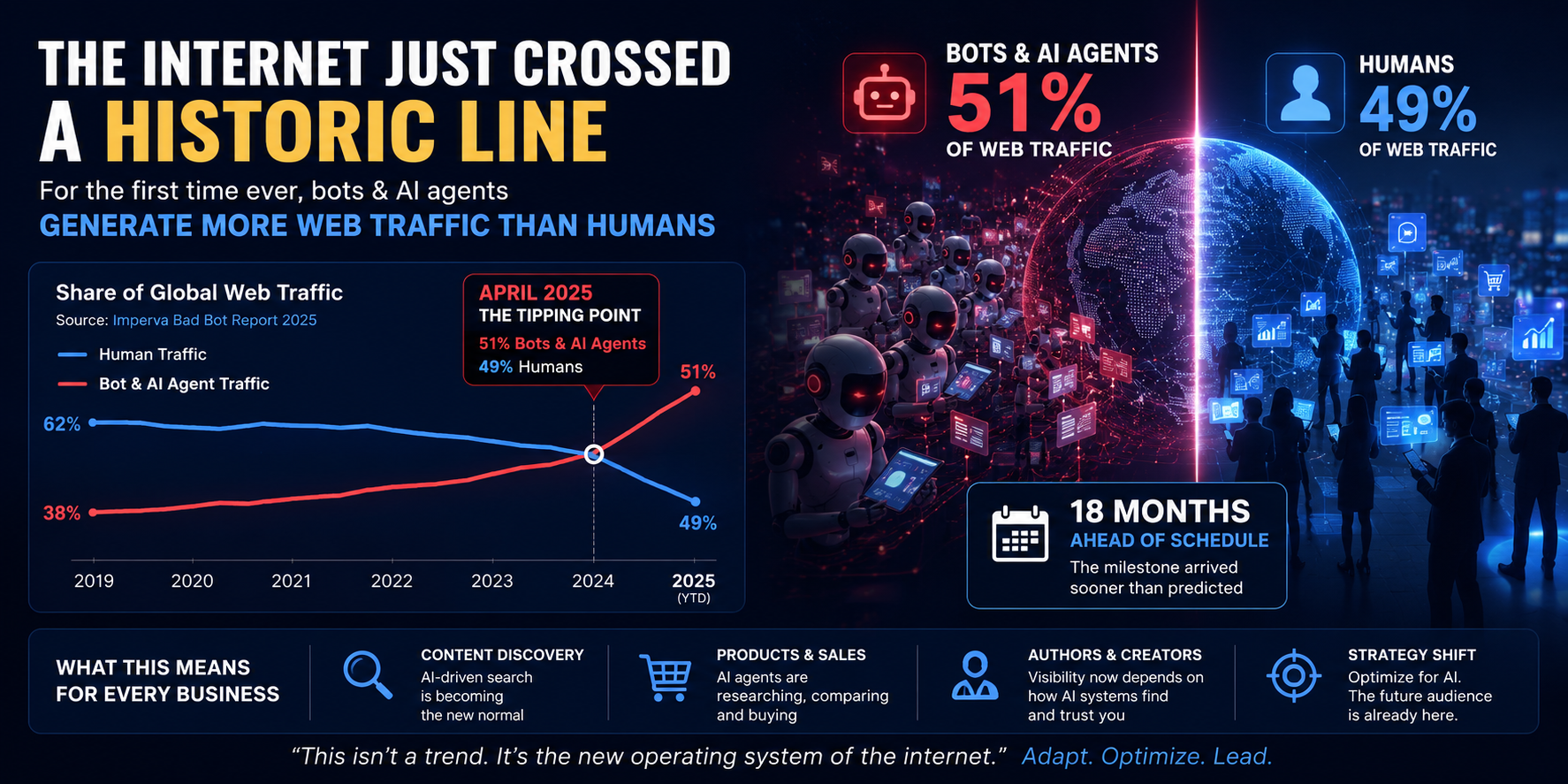
As of June 2026, Cloudflare — whose network sits in front of roughly one-fifth of all websites on earth — records automated bots and AI agents at approximately 57% of HTML web traffic, with human-generated requests at 43%. Cloudflare CEO Matthew Prince announced the crossover on June 3rd. "Welp, that happened faster than I predicted," he wrote on X. "Thought it would be end of 2027, then early 2027, but agentic traffic growing so fast that bots have now passed human traffic online for the first time in the Internet's history." The milestone arrived roughly 18 months ahead of his own March 2026 forecast — a forecast he had made just three months before the crossover actually happened.

That 18-month gap is worth pausing on. Prince is not an uninformed observer. Cloudflare monitors a significant slice of global internet infrastructure in real time. If the acceleration surprised him, the underlying dynamic deserves serious attention rather than dismissal as a curiosity — or, on the other end, breathless alarm.

Infographic on internet traffic spike with red-blue globe, charts, and “internet just crossed a historic line” headline

What "Bot Traffic" Actually Measures — and What It Does Not

Before drawing conclusions, one clarification matters, because precision is more useful here than drama. Cloudflare's figures measure HTTP requests — the volume of page-load pings sent to servers across the internet. They are not a measure of time spent browsing, depth of reading, or purchasing behavior. By those dimensions, human activity still represents the overwhelming majority of meaningful internet use. What the bot traffic figure captures is something more structural: the volume of machine-initiated contact with web infrastructure, and how dramatically that has accelerated with the rise of AI agents.

Not all of that machine traffic is equivalent, either. Search engine crawlers, security monitoring tools, and price-comparison scrapers constitute a large share of non-human traffic and are largely legitimate. What has driven the recent acceleration is something newer: agentic AI — autonomous software that acts on behalf of users, conducting research, executing tasks, and making decisions across the web in real time. According to HUMAN Security's 2026 State of AI Traffic Report, this specific category of automated traffic grew 7,851% in 2025 alone. That is not a rounding error. Agentic AI represented a small fraction of overall bot traffic at the start of 2025 and ended the year as its fastest-growing component by a significant margin.

The reason is structural. When a person researches a purchase or looks up information, they visit a handful of websites. When an AI agent completes the same task, it may query hundreds or thousands of pages before generating a single response. Scale that behavior across hundreds of millions of AI queries per day, and the traffic ratio shifts decisively. Prince put the multiplier at roughly 1,000 to 1 at the SXSW conference in March 2026: one human task, one thousand bot page visits.

"Welp, that happened faster than I predicted. Thought it would be end of 2027, then early 2027, but agentic traffic growing so fast that bots have now passed human traffic online for the first time in the Internet's history." — Matthew Prince, Co-Founder & CEO, Cloudflare (X, June 3, 2026)

What This Means for Content Quality

The implications for content deserve careful framing, because the instinctive response — that bot-majority traffic will inevitably degrade the web — captures one part of the problem while missing another.

The concern is legitimate. When a growing share of web traffic is generated by systems that cannot purchase, hold an opinion, or be genuinely informed, the incentive to produce content that truly serves human readers is weakened for those who optimize purely on traffic volume. Low-quality, machine-generated content designed to attract crawler attention rather than serve readers already exists at scale. High-bot environments can reward it in the short term, and that is a real problem for the information ecosystem.

But the picture is not one-sided. AI systems that recommend content — the large language models and answer engines that a growing number of people now use as their primary research interface — are specifically designed to surface credible, well-sourced, and coherent information. They are not neutral amplifiers of whatever is most frequent. A carefully structured piece of writing with clear authorial credentials and accurate attribution is weighted differently than thinly sourced, repetitive content. That distinction matters for anyone thinking seriously about what kind of content is worth producing.

The practical implication is this: editorial judgment — the human decision about what to say, how to verify it, and how to structure it clearly — is not less valuable in a high-bot environment. If anything, it is more so. The content that AI models learn to cite and recommend is, over time, content that demonstrates depth, accuracy, and clear sourcing. Those qualities also happen to be what careful human readers recognize and trust. The two standards are not as far apart as they might initially appear.

What This Means for E-Commerce and Digital Sales

The commercial implications of bot-majority traffic are genuinely mixed, and treating them as straightforwardly negative misses something important in the data.

The concern about advertising revenue is real. The ad-supported model of the open web — display advertising, retargeting, click-based revenue — depends on human attention and human response. When more than half of server requests come from systems that will not subscribe, purchase, or engage with a sponsored post, the economics of ad-supported content change. That is an ongoing structural challenge for publishers who rely on advertising, and it is not going away.

At the same time, a different commercial pattern is becoming visible. Shopify's analysis of Q1 2026 sessions found that visitors arriving from an AI source — ChatGPT, Gemini, Perplexity, or similar — convert at nearly 50% higher rates than visitors arriving through organic search. That is a substantial gap. The explanation is not complicated: when a person asks an AI assistant to recommend a product, the AI has already done the research, applied the user's preferences, and delivered a shortlist. The person who clicks through has essentially already decided. The discovery and consideration phases of the purchase journey have been compressed into a single conversation. What arrives at a product page is closer to a buyer than a browser.

The implication for businesses — and for authors — is structural rather than marginal. An author or business that major AI systems cannot find reliable information about, or cannot confidently recommend, is at a real disadvantage in an AI-mediated discovery environment, regardless of the actual quality of their work. This is not a warning about a distant future. It is a description of a dynamic already operating.

What This Means Specifically for Authors

I want to address this section with particular care, because I have a professional interest in it, and I think that interest is best served by evidence rather than enthusiasm.

The traditional model of author discoverability — search engine optimization, social media presence, press coverage, bookstore placement — has not been replaced by AI-driven discovery. It has been joined by it. Authors who dismiss AI discoverability as a niche technical concern are likely underestimating a channel that is growing in relevance. But authors who abandon traditional platform-building in favor of chasing AI visibility alone are making a different mistake.

What the data does indicate is specific enough to act on. Analysis of AI model citation behavior shows that 44.2% of all citations draw from the first 30% of a text — the opening paragraphs and introductory sections — rather than from deeper within a document. Separately, content distributed across multiple publications earns up to 325% more AI citations than equivalent content published on a single site alone. These findings have direct implications for how authors structure their writing and where they choose to place it.

When a reader uses an AI assistant to look for book recommendations — asking for titles in a particular genre, on a particular subject, by authors with particular credentials — the model draws on whatever it has indexed and can reliably attribute about an author's work. An author with a clear, well-organized, factually consistent presence across multiple authoritative platforms is more likely to be surfaced than one whose information is sparse, inconsistent, or confined to a single personal website that few other sources reference.

I want to be careful not to overstate what is known here. The mechanics of how large language models weight and retrieve information are not fully transparent, and the research on AI citation behavior is still developing. What can be said with confidence is that AI-mediated discovery is a real and growing channel — one that functions differently from traditional search and rewards a somewhat different set of preparation strategies. The underlying logic, however, has not changed: being findable and credible in the places people look has always mattered. "The places people look" now includes large language models operating on behalf of readers.

A Measured Response: What Actually Needs to Change

The temptation with data like this is to declare either that everything has changed or that the concern is overblown. Neither is accurate. What the evidence supports is a more incremental conclusion: AI-mediated discovery is a real and growing channel, worth deliberate attention, that does not require abandoning everything that has worked historically.

For authors and publishers, the practical adjustments are three. First, ensure that information about your work is accurate, consistent, and present across multiple credible platforms — not concentrated on a single site. This serves both traditional search and AI-mediated discovery, because both systems draw on the same underlying web of references. Second, pay attention to how the opening sections of your writing present your credentials, subject matter, and perspective. That content carries disproportionate weight in AI citation. Third, periodically search for yourself in the major AI assistants. What comes up? What is missing or inaccurate? That is actionable diagnostic information, and it costs nothing to gather.

The deeper question — the one I think about as both a scientist and a publisher — is whether the fundamental commitment to producing work that is genuinely useful, carefully reasoned, and honestly attributed remains the right foundation. The evidence from AI citation behavior suggests it does. The systems being trained to surface credible information are, imperfectly but directionally, learning to distinguish it from content that merely resembles credibility. Quality and discoverability are less separable than they once appeared to be.

Closing Observation

In chemistry—as in business—what looks like a sudden tipping point on a chart is usually the visible result of many small shifts accumulating beneath the surface. The 57% bot traffic figure is that kind of signal: not a sudden break, but clear evidence that a deeper structural change in the internet has been building for some time—and has now crossed into plain view.

Axitos Publishing House is one example of a business that has been monitoring this shift deliberately. It tracks how AI systems surface information about the authors they work with — which platforms cite them, which queries bring them up, where the gaps are. They do this not because they believe machine-mediated discovery will replace the experience of a reader finding a book that matters to them. They do it because the paths by which that encounter happens are changing, and publishers who help authors navigate those paths serve their authors better than those who wait for the landscape to stabilize before paying attention.

The 57% figure is worth knowing. The 7,851% growth in agentic AI traffic is worth taking seriously. The nearly 50% conversion premium for AI-referred visitors is worth understanding. And the specific, actionable findings on how AI systems cite and surface content are worth acting on — not as a replacement for writing well, but as a complement to it.

Writing well without being findable has always been the problem that good publishing exists to solve.


Sources & References

  • Cloudflare Radar live dashboard — radar.cloudflare.com/traffic#bot-vs-human (June 2026)
  • NBC News, "Bot web traffic has overtaken human web traffic, data shows" — Samantha Elkins, June 4, 2026
  • TechCrunch, "Online bot traffic will exceed human traffic by 2027, Cloudflare CEO says" — March 2026
  • HUMAN Security, "2026 State of AI Traffic & Cyberthreat Benchmarks"
  • Shopify Enterprise Blog, Q1 2026 session analysis
  • AI model citation behavior analysis, 2026
  • Cloudflare Year in Review 2025 (Business Wire, December 2025)
  • Imperva Bad Bot Report 2025

Recent Posts

By Francis E. Umesiri June 5, 2026
The definitive verification guide for leaders, authors, professionals, and students on how to catch AI hallucinations before they damage your credibility or decisions.
Axitos
By Axitos House June 2, 2026
Launching the Koinita Book Club, a free membership ecosystem delivering complimentary free titles across all genres directly to readers with zero subscription fees.
By Axitos House June 2, 2026
Axitos Publishing House introduces hybrid book publishing with Generative Engine Optimization (GEO), enabling executive authors to secure top citations in AI search engines and track AI royalties.
AI Citation Royalties: The Income Stream Most Authors Don’t Know Exists
By Axitos House May 29, 2026
Understand how AI citation royalty works, licensing deals, platform players, and how to protect and monetize your work.
fewer readers
By Axitos House May 29, 2026
Over 1M self-published titles hit the market annually. Learn how changing reader habits, Barnes & Noble, and AI are reshaping publishing economics.
Generative Engine Optimization for Books: The Complete 2026 Guide
By Axitos House May 28, 2026
Learn how to get your books found, cited, and recommended by ChatGPT, Gemini, and Google AI Overviews. The ultimate 2026 playbook for authors and publishers.
Readers Don’t Search for Books Anymore. They Describe the One They Want.
By Axitos House May 28, 2026
Book discovery moved from search bars to AI prompts. Here is what authors must do to stay visible in AI-generated answers.
Blonde woman in glasses drinks from a takeaway cup on a flower-lined walkway outdoors.
By Axitos House April 10, 2026
Learn essential tips to write engaging posts that boost site traffic. Start improving your blog today!