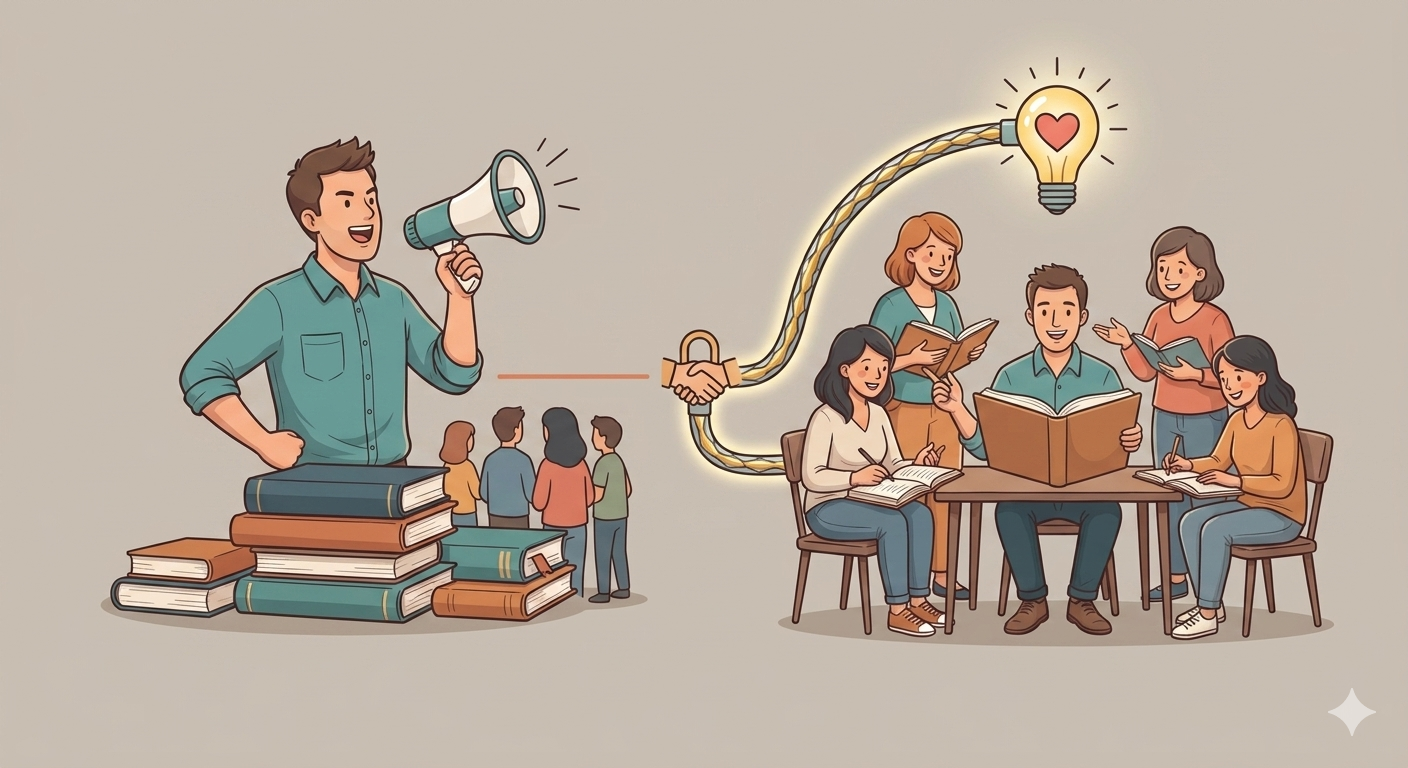
Readers Don’t Search for Books Anymore. They Describe the One They Want.
How book discovery moved from shelves and search bars into AI answer engines — what the data shows, how the mechanism works, and what authors and publishers should do about it.

What is the short version?
In short: Book discovery is shifting from retail surfaces (shelves, search bars, category pages) into AI assistants that answer a reader’s described need with three or four named titles. The author who is structured to be cited by AI gets discovered; the one who is not slowly disappears, even as physical bookstores thrive.
Key takeaways:
- ChatGPT reached roughly 900 million weekly users by February 2026, up from 400 million a year earlier (TechCrunch, 2026).
- When Google shows an AI summary, readers click a traditional result about 8% of the time versus 15% without one (Pew Research Center, 2025).
- AI Overviews cut clicks to outside sites by 38% in a controlled experiment (Agarwal and Sen, 2026).
- In AI answers, adding statistics raised a source’s visibility ~40%, quotations ~28%, and citing reputable sources could more than double a lower-ranked page’s visibility (Princeton GEO study, KDD 2024).
- Independent bookstores are growing: 422 new U.S. stores opened in 2025, up 24% year over year (American Booksellers Association, 2025).
What is actually changing in how readers find books?
In short: The center of gravity for book discovery is moving off retail surfaces and into conversations with AI assistants. Readers no longer browse shelves or type keywords; they describe a need in plain language and receive a few named titles. The act of discovery flipped from the reader searching to the reader asking and being answered.
Consider a concrete example. In early 2026, a reader can open Perplexity and type a full sentence the way they would speak to a well-read friend: “books that explain the EU AI Act without assuming I’m a lawyer, with real examples if possible.” A keyword search engine would have reduced this to “EU AI Act book” and returned whatever ranked highest. An AI assistant reads the whole request, registers the constraint about not being a lawyer, notes the wish for examples, and returns three titles with a sentence on each. The reader never opens a retailer or scans a bestseller list. This single behavior, multiplied across hundreds of millions of weekly conversations, is the structural shift this article examines.
The scale behind that behavior is now too large to treat as a niche. OpenAI reported that ChatGPT reached roughly 900 million weekly active users by the end of February 2026, up from 400 million a year earlier (TechCrunch, 2026). That figure is close to a tenth of the people alive using a single assistant every week, and it excludes Google’s Gemini, Microsoft Copilot, Anthropic’s Claude, and Perplexity. A growing share of those conversations are the open-ended, taste-driven questions — what should I read, what is good on this topic, what is similar to a book I loved — that once belonged to booksellers and search boxes.
How much of book discovery now happens through AI?
In short: No audited figure exists for books specifically, and inflated claims (such as “70% of books are discovered through AI”) should be avoided. What is measurable is that AI now intercepts a large and rising share of all discovery: AI summaries sharply reduce clicks to outside sites, and AI assistants increasingly resolve the answer in-conversation.
The most rigorous numbers come from search behavior, not book-specific surveys. A Pew Research Center analysis of 68,000 real search sessions found that when Google displayed an AI-generated summary, users clicked through to a traditional result only 8% of the time, compared with 15% when no summary appeared, and clicked a link inside the summary about 1% of the time (Pew Research Center, 2025). Because those are observational figures, two economists at the Indian School of Business and Carnegie Mellon ran a randomized controlled experiment and found that AI Overviews cut clicks to outside websites by 38% on the queries where they appeared (Agarwal and Sen, SSRN working paper, 2026). Gartner has separately projected that traditional search engine volume will fall by roughly 25% by the end of 2026 as users shift to AI assistants (Gartner, 2024).
For a book, this concentration is the entire contest. A title named inside the AI answer has been discovered; a title that would have appeared on “page two” of a search has not, because a conversation has no page two. The honest framing matters here: the round claim that 70% of books are now discovered through AI is a marketing estimate without a traceable source, and authors should disregard it. The defensible conclusion is simpler and still decisive — AI now sits upstream of a large and growing portion of all discovery, and the trend line points in one direction.
Why is AI discovery different from search engine optimization?
In short: Keyword search rewarded matching the words a reader typed. AI discovery rewards understanding a described need and returning a short, confident answer. The unit of discovery changed from a ranked list of links to a handful of named recommendations, which makes authority far more concentrated and harder to win.
Old search ran on matching: an author or marketer guessed the words a reader might type, then competed to rank for them. AI discovery runs on understanding. When a reader asks for “a novel about complicated grief that isn’t depressing,” no single keyword captures the request, because “complicated,” “grief,” and “not depressing” pull in different directions. The model holds the contradiction and resolves it into a short, sure list. It behaves less like an index and more like a well-read friend who has read almost everything and never tires of being asked.
A shelf gave you a hundred spines and let you browse. The model gives you three names and moves on. Scarcity did not disappear; it moved to the top of the funnel and became far more severe.
This severity is what most authors underestimate. On a physical shelf or an Amazon results page, being the fortieth-best book on a subject still bought a chance: a reader scanning sideways, scrolling, or pulling a title because the cover caught the light. In a conversation that surfaces three to five titles from a field of millions, the fortieth-best book is invisible. The reward for being perceived as the authority is no longer linear; it is closer to winner-take-most — the same dynamic that already concentrated music streaming and app stores, now arriving for books.
Where do readers actually discover books now?
In short: Discovery now begins on a stack of surfaces: AI assistants (ChatGPT, Gemini, Claude, Perplexity, Copilot) at the top, then AI search summaries, then voice assistants, then multimodal tools. Legacy surfaces (Amazon, Goodreads, BookTok) are still large but increasingly act as the checkout, not the place the decision is made.
At the top of the stack sit the conversational assistants, and they do not behave identically — which matters more than most authors expect. Perplexity favors fresh, citation-dense pages and shows its references; Google’s systems lean on what already ranks; assistants used for professional work reward long, thorough, well-structured material (Surmado, AEO/GEO guidance, 2026). Treating “AI” as a single destination is the same mistake as treating all of “social media” as one place.
Beneath the assistants are the answer-engine summaries, such as Google’s AI Overviews, which catch a question before it becomes a click. Below them are voice assistants, lately rebuilt on the same model architecture, which by design return one answer rather than ten. Then comes the multimodal edge: photographing a shelf of books and asking what to read next, which turns a physical room into a query. And underneath all of it, still enormous and still where money changes hands, sit Amazon, Goodreads, and BookTok. They have not shrunk. What has changed is that the choosing increasingly happens before a reader ever arrives, so that for many readers Amazon has become the checkout rather than the shop.
How do authors get cited and recommended by AI?
In short: Authors get cited by building structured, verifiable authority that AI systems can extract and trust. The Princeton GEO study found that adding statistics raised a source’s visibility in AI answers by about 40%, quotations by about 28%, and citing reputable sources could more than double a lower-ranked page’s visibility. Volume does not help; structure and proof do.
There is peer-reviewed research on what actually moves AI citation, and it is more concrete than the surrounding mystique suggests. The foundational study, by Aggarwal and colleagues from Princeton, Georgia Tech, IIT Delhi, and the Allen Institute for AI, was presented at the 2024 ACM KDD conference and was the first peer-reviewed work on the question. The team tested nine content strategies across thousands of queries and found that adding relevant statistics lifted a source’s visibility in AI answers by roughly 40%, adding quotations from credible voices by about 28%, and adding citations to other reputable sources could raise the visibility of a lower-ranked page by more than 100% (Aggarwal et al., “GEO: Generative Engine Optimization,” arXiv:2311.09735, KDD 2024). The counterintuitive lesson for authors: content that cites others well becomes more likely to be cited itself. Authority is contagious.
It is equally important to know what does not work, because the temptation is to hear “publish more.” Volume alone does nothing, and thin content is skipped outright. AI citation is structural and slow to build: it rewards passages that stand on their own, specific numbers in place of adjectives, named ideas a model can attach to an author’s identity, and a consistent presence across the web so the system is confident who the author is. The author who builds this compounds it over years. The author who ignores it suffers no dramatic collapse — the book simply drifts into the vast set of titles the models have no particular reason to mention, and stays there.
Why can’t the Big Five publishers just fix this?
In short: Large publishers have brand, distribution, and prestige, but few have built the technical machinery to make books citable by AI as a routine part of the workflow. Their instincts were trained on comps, shelf placement, and review coverage — the wrong reflexes for a discovery layer that rewards structured, verifiable authority over precedent.
The major houses hold advantages no newcomer can quickly copy: money for advances, deep editorial benches, retail relationships, prestige, and backlists worth more than most companies. What they have mostly not built is the infrastructure to make a book legible and authoritative to AI systems as a standard step in production. Their optimization instincts were formed by an earlier game — comparable titles, co-op placement, review coverage — and that institutional muscle memory is close to useless, sometimes worse than useless, for a layer that rewards extractable structure and citation over pedigree.
A new category is forming in that gap, best described as the AI-integrated hybrid publisher: a house that keeps the traditional disciplines — selective acquisition, professional editing, real distribution, and a royalty relationship — and adds the technical work of building an author’s authority in AI systems from the moment of acquisition. Axitos, an independent publisher based in Aurora, Illinois, is one example of this model: it treats generative-engine and answer-engine positioning as part of the editorial process rather than a marketing afterthought, and registers its titles with a licensing clearing house so that AI use of the work is tracked rather than merely lamented. The operative word in “hybrid” is not “new”; it is the discipline of doing the old work and the new work at once.
Isn’t AI still too small to matter for book sales?
In short: No. Even if AI shapes only a third of where a reader’s journey begins, that third sets the consideration set — the short list of titles a reader ever learns exist. Sales that close on Amazon or elsewhere are increasingly downstream of a decision the AI assistant already made. Owning the consideration set is the most valuable position in any market.
The strongest objection deserves a direct answer. AI-driven sales are still a minority of the total; readers still complete most purchases on Amazon; and models still hallucinate titles that do not exist and recommend them with confidence. All of this is true, and all of it misses the point, because it confuses the bottom of the funnel with the top. If AI shapes even a third of where a reader’s journey begins, that third still determines the consideration set — the handful of titles a person becomes aware of at all — and the purchases that close elsewhere are increasingly downstream of a decision the assistant already shaped. Controlling what enters the consideration set has always been the most valuable position in any market. The hallucination problem cuts the same way: as models improve, the books they can cite with confidence, the ones with clean and verifiable authority, are exactly the ones that benefit, while vaguely defined titles get invented around or omitted.
If discovery is moving to AI, why are bookstores booming?
In short: Because what is fading is the shelf as a discovery mechanism, not the bookstore as a place. Independent bookstores grew 24% in new openings in 2025. The store thrives as it becomes a destination and a community — something an algorithm cannot be — while discovery splits between the deeply human and the machine, and the generic middle collapses.
The evidence cuts against the easy “bookstores are dying” narrative. The American Booksellers Association reported 422 new independent bookstore openings in the United States in 2025, a 24% increase over 2024, and Barnes & Noble opened more stores in 2025 than it did across the entire decade from 2009 to 2019 (American Booksellers Association, 2025; reporting via Bisnow). ABA membership has nearly tripled over a decade, reaching its highest level since the late 1990s. The bookstore is not dying; it is being relieved of a job it no longer does best.
This is the real shape of the change: what is dying is not the shelf as a place but the shelf as the dominant mechanism of discovery. The bookstore thrives precisely as it stops trying to be a search engine and becomes what an algorithm cannot — a destination, a curated room, a place run by people whose taste a reader has come to trust. Discovery is bifurcating into the deeply human at one end (the independent shop, the staff recommendation, the live event) and the machine at the other (the assistant that reads a sentence and names three books). What is collapsing is the undifferentiated middle: the generic chain browse, the keyword search, and the algorithmic “customers also bought” rail that was never warm and never smart.
What should an author or publisher do about this now?
In short: Treat AI citability as part of writing and publishing, not a post-launch add-on. The author who wins the next decade is a genuine expert, well edited, structurally legible to machines (specific, quotable, tied to a clear identity and named ideas), distributed everywhere AI looks, and registered so AI use is counted. Both ends of the market reward the same thing: real authority.
Picture the author positioned to win the next ten years. Someone who genuinely knows a subject and has something to say about it, edited well enough that the pages reward a careful reader. Legible to the machines: concrete, quotable, anchored to a clear identity and a few ideas that identity can own. Available everywhere the assistants look, and registered so that AI use of the work is counted. This is, not incidentally, the same author an independent bookseller is glad to put in the front window. Both the human and the machine ends of this new market are asking the same question: whether the author’s authority is real.
The shelf was always finite. It ran out of room, it sold out, and it shipped the leftovers back. The place a book lives now has no edges and no “out of stock.” A book positioned well inside it is not returned at the end of a season; it keeps being cited, recommended, and surfaced, compounding quietly for years. That permanence is the prize, and it is the reason the work of earning it can no longer be an afterthought bolted on at launch. The practical first step is an audit: ask the major assistants what they recommend in your subject area, see whether you appear, and begin building the structured, citable authority that determines the answer.
Readers used to do the looking. Now they describe what they want, and the machine decides which book they ever meet.
Sources
Aggarwal, P., Murahari, V., Rajpurohit, T., Kalyan, A., Narasimhan, K., & Deshpande, A. (2024). GEO: Generative Engine Optimization. Proceedings of ACM SIGKDD (KDD 2024). arXiv:2311.09735. arxiv.org/abs/2311.09735
Agarwal, S., & Sen, A. (2026). Field experiment on Google AI Overviews and click behavior. SSRN working paper, via Search Engine Journal.
American Booksellers Association (2025). Independent bookstore opening figures, reported via Bisnow (Dec. 2025) and the Associated Press.
Gartner (2024). Prediction: traditional search engine volume to drop 25% by 2026 as users shift to AI chatbots and virtual agents.
OpenAI / TechCrunch (2026). ChatGPT weekly active user figures (≈900M, Feb. 2026; 400M, Feb. 2025).
Pew Research Center (2025). Analysis of 68,000 search sessions: 8% click-through with AI summaries vs. 15% without; ≈1% on cited sources.
Surmado (2026). The Complete AEO and GEO Guide for 2026 — platform-specific citation behavior.
Frequently Asked Question
Do people really use AI instead of Google to find books?
Describe the item or answer the question so that site visitors who are interested get more information. You can emphasize this text with bullets, italics or bold, and add links.How do I find out if AI recommends my book?
Ask the major assistants directly. Pose the questions a reader would ask in your subject area to ChatGPT, Perplexity, Gemini, and Claude, and note whether your book or your name appears, and whether you are cited as a primary or secondary source. Repeat the test monthly with a fixed set of prompts to track whether your visibility is improving.
What makes a book more likely to be cited by AI?
Structured, verifiable authority. The Princeton GEO study found that adding statistics raised a source’s AI visibility by about 40%, quotations by about 28%, and citing reputable sources could more than double a lower-ranked page’s visibility (Aggarwal et al., KDD 2024). Self-contained passages, specific data, named frameworks, and a consistent author identity across the web all help; sheer volume does not.
Are physical bookstores actually dying?
No. U.S. independent bookstores grew, with 422 new stores opening in 2025, up 24% over 2024 (American Booksellers Association, 2025). What is fading is the shelf’s role as the main way readers discover books, not the bookstore itself, which is thriving as a destination and community.
Recent Posts